
The work nobody owns.
Every team can do its job well and an opportunity can still fall between them. Someone usually notices. The question is who decides what it adds up to, and what it costs the person who takes it on anyway.
An organisation can assign every responsibility and still leave important work without an owner. Each team hears a fragment and nobody decides what it adds up to. The gap falls to whoever cannot leave it alone. Ask who can notice it, who can decide, who will make sure it doesn’t disappear, and what the person who notices should do.
On this page9 sections
In 2011, three researchers writing in Harvard Business Review sent a test enquiry through the websites of 2,241 US companies and timed the replies. Almost a quarter took more than a day to answer. Another 23% never answered at all.
The enquiry arrived where it was supposed to. Whatever was meant to happen next belonged to nobody in particular, so it did not happen.
An unanswered form is the visible version of a quieter problem. Imagine a laboratory manager who asks your application scientist a question at a demonstration. A month later, a buyer asks your sales lead something similar, and your website shows people searching for the same thing and leaving after one page. Each person who hears it answers well. Nobody decides what it adds up to, unless one of them decides to take it on, on top of their own job.
An organisation can assign every responsibility and still leave important work without an owner.
What happens to an opportunity that everybody can see a piece of, but nobody is positioned to deal with as a whole? And what happens to the person who picks it up anyway?
No gaps on the organisation chart, gaps in the work
Follow that question through your own company. The application scientist explains what the product does today and what has not been tested for that use. The sales lead files it as a future product question. Marketing sees the searches but has nothing technical to publish. Engineering has no development request to act on.
Nobody has dropped a task. Every response is reasonable. And the company never finds out whether a real need is forming in its market.
Each of those people is also behaving the way people reliably behave when a responsibility is shared. In a 1968 experiment, the psychologists John Darley and Bibb Latané had students talk over an intercom, during which one of them appeared to have a seizure. Of those who believed they were the only listener, 85% reported it before the fit ended. Of those who believed four others could also hear it, 31% did. An office is not an emergency, but the reflex carries over: the more people who could act, the easier it is for each to assume that someone else will.
The missing work is a decision: whether the fragments add up to something worth acting on. It has no obvious departmental home, so it waits.
Dividing work is easier than putting it back together
Specialisation is not the problem. No technical product can be designed, tested, marketed, sold and supported by everybody helping with everything.
But dividing the work is only half of organising it. In a 2000 paper, Chip Heath and Nancy Staudenmayer gave the missing half a name: coordination neglect. People find it natural to split a task into parts and easy to underestimate the effort of fitting the parts back together.
Part of the reason is that division is visible. You can draw departments, appoint managers, write job descriptions and report on each team’s performance. Coordination is harder to draw. It happens in questions, interruptions and judgements that never appear in a workflow.
Who notices that two teams are working from incompatible assumptions? Who decides whether a customer’s objection is a misunderstanding or a real limit of the product? Who checks a promise made on a sales call before it becomes a contract? Who follows the issue when the person who noticed it has no authority to resolve it?
Leave those questions unanswered and the work does not go away. It becomes harder to see.
The gaps differ, and so do their fixes. Some need a person with the authority to decide. Some need a clear route for escalating. Some need the company to admit it has been describing the problem wrongly.
The customer does not experience your departments separately
Marketing and business development show the problem clearly because their work looks like a sequence. Inside a CRM, a lead is generated, a contact created, an opportunity moved through its stages and a deal closed.
Your customer does not experience it that way. The same person reads a technical article, speaks to someone in sales, asks for a demonstration, comes back to the website to check something that still bothers them and talks it over with colleagues. Their understanding builds across all of it, and so do their doubts.
So marketing can report a successful campaign while business development reports stalled conversations, and neither is wrong. What matters is whether anybody is responsible for putting the two side by side and deciding what should change.
Why don’t dashboards show unowned work?
Unowned work survives even in companies full of data, because most management information follows the lines of assigned work. Marketing reports reach and enquiries. Sales reports pipeline and revenue. Engineering reports delivery. Support reports tickets closed.
Each measure can be accurate while the company understands less and less about what its parts achieve together. In the opening example, marketing sees relevant readers, sales sees conversations that stall and product sees no formal requests. The opportunity sits between the three descriptions and in none of them.
A dashboard shows the activity a company has defined and assigned. It cannot show work nobody has defined, and it cannot show who is quietly doing it.
The most useful observation may be a sentence customers keep repeating: We would consider this, but we cannot see how it fits our existing process. Where does that sentence go in your company, and who can act on it?
Who ends up doing the work nobody owns?
In most companies the gap between teams does get filled, by a person. It is the colleague who forwards the customer’s question to the right scientist, spots that two proposals promise different things, tells marketing what sales keeps hearing and chases the decision that nobody has put in a diary.
The software engineer Tanya Reilly calls this glue work: “noticing when other people in the team are blocked and helping them out”, reviewing documents for what is inconsistent, onboarding new people, improving processes. It makes the team better, she writes, “but people aren’t always rewarded for doing it”. Done too early in a career, it “can be career limiting”.
Linda Babcock, Brenda Peyser, Lise Vesterlund and Laurie Weingart describe the wider category in The No Club as non-promotable work: tasks that matter to an organisation but do not advance the career of the person doing them. Their research also shows that it does not land evenly. In a study published in 2017, female faculty at a large university were 2.7 times more likely than male faculty to volunteer for a committee. In laboratory experiments in the same study, both men and women were 12 percentage points more likely to ask a woman to volunteer than a man. The researchers attribute part of the gap to expectations: people expect women to volunteer, and women agree to such requests more often than men do.
The load concentrates in another way too. In their research on collaboration at work, Rob Cross, Reb Rebele and Adam Grant found that, in most cases, 20 to 35% of the collaborations that add value come from just 3 to 5% of employees. Those people become “institutional bottlenecks”: work waits until they have weighed in, and they are so stretched that their own work suffers.
So the work nobody owns usually has an owner after all. It is whoever cannot leave it alone, and the organisation that relies on them rarely records what it costs.
That is also why handing a problem to whoever raised it is a mistake. Someone notices an inconsistency in a customer promise and ends up fixing the quote. Someone spots that two systems disagree and is asked to reconcile them. Someone sees an unmet market need and is expected to write the business case on top of their actual job. It looks like initiative. Over time, it teaches people to stay quiet, or wears out the few who don’t.
The person who notices a problem often lacks the information, time or authority to resolve it, and where a quality or regulatory specialist owns the decision, raising it must not become a way around them.
Gerardo Okhuysen and Beth Bechky offer a helpful way to separate these things. Their 2009 review of coordination research argues that plans, routines, meetings and similar arrangements help people work together by producing three things: accountability, predictability and common understanding. You can know who is accountable without understanding the problem, or share an understanding with nobody authorised to decide. For an issue that crosses departments, that means separating four roles: who raises it, who decides what happens next, which specialists assess it and who checks that the decision took effect. Then the person who noticed is not automatically the person who carries it.
Make it possible to stop the line
Toyota’s production system offers a useful contrast. Building cars is not developing a B2B market, but Toyota makes the handling of an emerging problem unusually visible.
Within Toyota’s jidoka approach, a worker who detects an abnormality can signal it using the andon system. At the company’s Burnaston plant in the UK, Toyota describes how pulling a cord identifies the workstation and calls for assistance. If the issue cannot be resolved within the allotted process time, the line pauses while it is investigated. Toyota also explains this principle in its global description of the Toyota Production System.
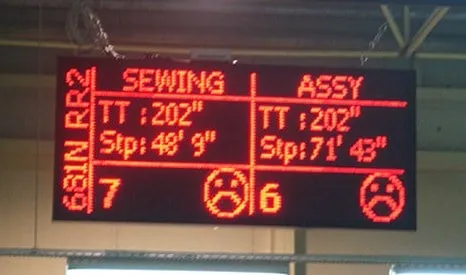 An andon board at an automotive parts supplier, showing stoppages on two lines. Mustafasari, public domain. Source

Most companies already have ways to report a problem. Toyota’s difference is that the signal comes with an expected response. The worker who pulls the cord is not asked to fix the line alone. Someone is called, the problem has a location, and the organisation has accepted that ordinary work may stop until the abnormality is understood.
No company should let every employee halt any commercial project. But the andon cord raises a fair question: when somebody notices that work is going wrong between teams, what are they actually able to do?
Can your marketer ask for a commercial decision instead of another campaign brief? Can anyone bring the right people together before the issue is expensive enough to reach senior management? ‘Raise it with your manager’ is not an answer. It says where the message goes, not what happens next.
Often what is missing is the decision itself. Put the people who each heard the question into one conversation and it could end several ways: the need is real, the evidence is thin, the work is too large, or the problem is how the product is explained. Each of those is a useful answer, as long as someone has the authority to reach it and the decision leads to a next step. Without that, the same conversation returns in different departments for months, each time looking like a new observation.
Somebody has to own the whole
The stakes are not always a missed opportunity. On 20 May 2018, Britain’s railways introduced what the regulator called “the biggest timetable change in a generation”. Govia Thameslink Railway planned to run 3,880 trains a day; around 270 a day did not run at all. The regulator’s inquiry found mistakes at five organisations and “an apparent gap in industry responsibility and accountability for managing systemic risks”. Each organisation had people responsible for its own part. Nobody owned the risk between the parts.
Few companies face consequences on that scale, and seeing the same pattern in your own rarely calls for a reorganisation. The answer is usually modest: a named decision maker for questions that cross teams, a route for what support and sales hear to reach product planning, a rule for when a claim needs scientific review, and recognition for the people who do the connecting. Match the response to the stakes, since not every loose idea needs a committee.
Making everybody responsible for everything is no answer either. It dissolves the expertise and accountability organisations need, and in practice the work falls to the same few people again. The difficult part is letting questions cross boundaries without losing responsibility on the way.
For any issue that crosses your teams, three questions show whether that is happening:
Who can notice it? Who can decide? Who will make sure it doesn’t disappear?
And one for you, if you are usually the person who notices first:
What am I expected to do with something that isn’t mine, and would anyone notice if I stopped?
Questions
What is the work nobody owns?
The work nobody owns is work that falls between assigned responsibilities, such as deciding whether questions heard by different teams add up to something, checking a promise before it becomes a contract, or following an issue the person who noticed it cannot resolve. Nobody has dropped a task, so nothing looks wrong, but the opportunity between the teams goes unhandled.
What is glue work?
Glue work is Tanya Reilly’s term for the connecting work that keeps a team effective, such as noticing when others are blocked and helping them, reviewing documents for inconsistencies, onboarding new people and improving processes. She writes that people aren’t always rewarded for it, and that doing it too early in a career can be career limiting.
How can a company stop opportunities falling between teams?
A company can usually stop opportunities falling between teams with modest changes rather than a reorganisation: a named decision maker for questions that cross teams, a route for what support and sales hear to reach product planning, a rule for when a claim needs scientific review, and recognition for the people who do the connecting. It also helps to separate who raises an issue, who decides, who assesses it and who checks the decision took effect.
Sources
- Oldroyd, McElheran & Elkington: The Short Life of Online Sales Leads
- Darley & Latané: Bystander Intervention in Emergencies: Diffusion of Responsibility
- Heath & Staudenmayer: Coordination Neglect: How Lay Theories of Organizing Complicate Coordination in Organizations
- Tanya Reilly: Being Glue
- Babcock, Peyser, Vesterlund & Weingart: The No Club: Putting a Stop to Women’s Dead-End Work
- Babcock, Recalde, Vesterlund & Weingart: Gender Differences in Accepting and Receiving Requests for Tasks with Low Promotability
- Cross, Rebele & Grant: Collaborative Overload
- Okhuysen & Bechky: Coordination in Organizations: An Integrative Perspective
- Toyota Production System
- TMUK’s 25 Objects: Andon Cord
- ORR Inquiry concludes passengers let down by rail industry failures