
What happens to websites when AI answers everything?
The web was built around a simple habit: ask a question, open a page. AI is changing that habit. The more interesting question is what a website still offers once the answer arrives first.
AI-generated answers are reducing some visits to websites, particularly when a question can be settled with a short explanation. People still need places to check evidence, compare details, understand who is responsible for a claim and get something done. For organisations selling complex technologies, the value of a website may increasingly depend on how well it supports those moments.
On this page9 sections
 Checking batch records on a tablet in a cleanroom. Toon Lambrechts / MyCellHub, Unsplash. Source
Imagine a scientist looking for an explanation of a sequencing method. A few years ago, they might have opened a journal article, a manufacturer’s application note and a handful of comparison pages. Today, a search engine can assemble a plausible answer before they visit any of them.
That saves time. It also changes who gets the reader’s attention.
The scientist may leave with the explanation they wanted and no memory of the organisations whose work made it possible. The journal, manufacturer and specialist publisher did the work; the interface that combined their information received the visit.
It is tempting to call this the death of the website. But that prediction confuses one job the web has performed, answering common questions, with everything else people ask websites to do.
Do AI summaries reduce clicks to websites?
We have evidence that AI summaries are already reducing clicks to websites, although not every change can be attributed to AI alone.
In a 2025 study of browsing data from 900 US adults, Pew Research Center found that people clicked a traditional search result in 8% of Google visits with an AI summary, compared with 15% of visits without one. Links inside the summaries themselves were clicked in about 1% of visits where an AI summary appeared. The researchers also observed more sessions ending after an AI-summary page.
Those are observations from a particular sample and month, not proof that AI caused every missed click. Different query types may attract both AI summaries and different clicking behaviour. Even so, they describe a meaningful change: the search page can increasingly satisfy the question without handing the reader over to another website.
That affects the bargain much of the publishing web was built around. Someone creates information. A search engine helps people find it. Some of those people visit the original page, where the publisher can earn attention, build a relationship or sell something. If the answer arrives before the visit, part of that exchange disappears.
Cloudflare’s analysis of crawler and referral traffic exposed a similar tension. In June 2025, it estimated a crawl-to-referral ratio of roughly 1,700:1 for OpenAI’s crawler, compared with around 14:1 for Google’s crawler. Cloudflare cautioned that referrals from native applications are not always attributable through standard headers; these figures should not be read as a measure of all visits generated by either company.
A crawler request is not a search impression, and a referral is not a sale. What the figures do show is how far the extraction and distribution of information can drift apart.
An answer is useful until it becomes a decision
Suppose the scientist moves from a general question about sequencing to a purchasing decision. They need to know whether a particular workflow supports their sample type, what the claimed performance was measured against, how the data can be exported and which steps the laboratory will need to validate for its intended use.
A concise answer might narrow the options. It cannot responsibly stand in for the supplier’s complete, current documentation or the laboratory’s own evaluation. A technical limitation buried in a footnote may matter more than the feature named in the summary.
This is particularly obvious in life sciences. The distinction between research-use-only material and a product cleared or approved for a clinical purpose is consequential. A summary that drops the intended-use statement has lost something essential, even if the rest of its explanation reads perfectly well.
The same is true beyond laboratories. When a manufacturer publishes a tolerance, a software provider documents an integration or a specialist company revises a specification, the source is part of the claim. Readers need to know which version they are seeing and who stands behind it.
That suggests a change in what we expect from a company website. Many visits may start later in the decision process. The visitor already knows the category and has heard a summary of the alternatives. They arrive to inspect the evidence, test a claim or move a project forward.
For those visits, being clear about boundaries is often more valuable than sounding comprehensive.
The original source has a different kind of value
Consider PubMed, the search and retrieval service maintained by the US National Library of Medicine. It contains more than 40 million citations and abstracts from biomedical literature. PubMed often points readers to full texts held by publishers or PubMed Central rather than reproducing the entire work itself.
That structure is worth thinking about. A useful discovery service helps someone locate information, but it also preserves the trail: titles, authors, dates, identifiers and links to the work. Those details make claims checkable. A well-written summary can help a reader decide where to look; it should not make the underlying record disappear.
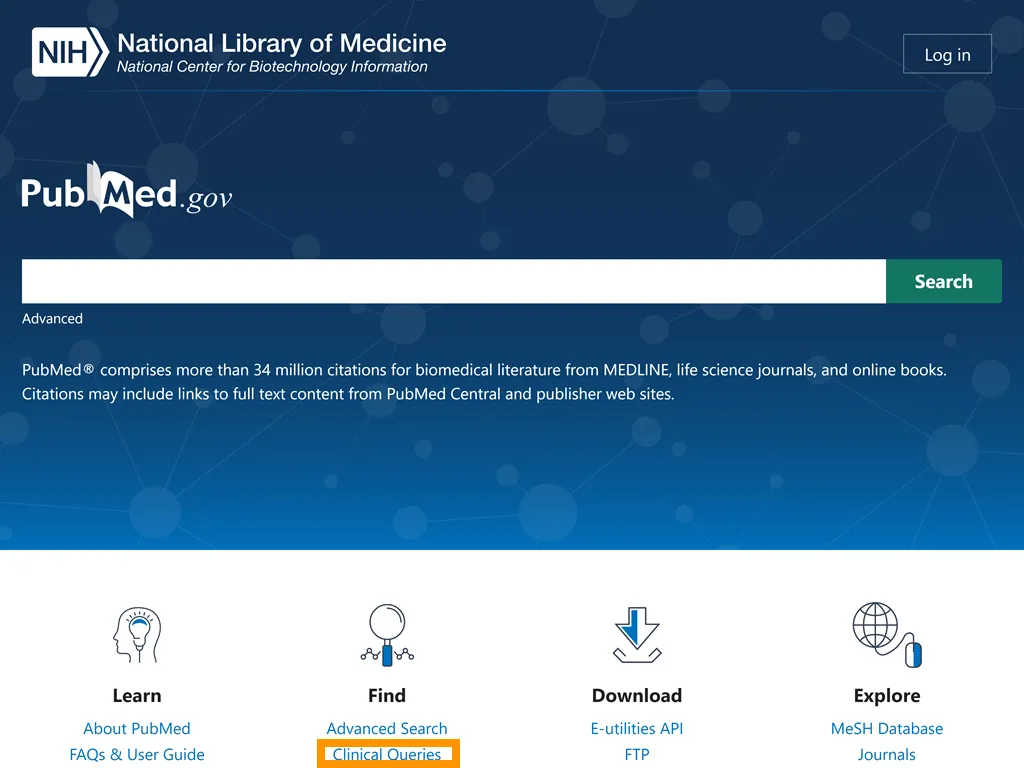 An archived PubMed screen, with historical figures. US National Library of Medicine. Source
There is another instructive example in science. In 2020, NASA’s Jet Propulsion Laboratory reported using machine learning to identify previously unknown impact craters on Mars. A classifier screened orbital images; researchers then used the HiRISE camera to confirm candidate discoveries. The published account gives the instrument names, the verification process and the people and organisations responsible.
A two-sentence AI answer can explain what happened. It is not a substitute for the original observation, the image or the account of how the finding was checked.
 A different recent impact site in Noachis Terra, Mars, seen by HiRISE. NASA/JPL-Caltech/University of Arizona. Source
This is why a useful distinction is emerging between an answer and a source of record. The answer is a convenient interpretation. The source of record contains the details needed to challenge, reproduce or act on that interpretation. Both can be valuable, but they serve different purposes.
The website can become a place to verify and act
A good website has never been just a collection of answers. It can offer an experience, a tool, a transaction, access to a person or a body of original evidence that cannot be replaced by a few paragraphs.
In the past, those purposes were often hidden behind large amounts of general explanatory content. Teams filled sites with broad introductions in the hope of being discovered. Some of that material genuinely helped readers. Some existed because the search market rewarded pages that could answer a familiar query.
If AI systems increasingly absorb those generic questions, the balance of effort may shift. An instrument manufacturer’s detailed methods, application-specific performance notes and comparison data could become more useful than another broad page explaining the technology category. A specialist software company’s integration documentation may do more to earn trust than a glossary. An interactive configurator or a well-designed route to a technical expert can help someone accomplish something that an answer alone cannot finish.
This is not a suggestion to hide basic information or remove educational content. Clear explanations still matter, especially when a technology is unfamiliar. They create the context in which more detailed evidence becomes meaningful. But general explanation should lead somewhere substantial.
A good test for a page is simple: after reading the answer, what could a serious visitor still need to do here? If the answer is ‘nothing’, the site may be vulnerable to becoming an invisible source. If the answer is ‘inspect the measurements, compare configurations, download the protocol, test the tool or speak to the team’, it has a job that a summary has not completed.
As software gets easier to build, a website can become a small working product: a compatibility checker, data explorer, model or calculator built around specialised knowledge. Such tools have to be reliable and carefully scoped. Their usefulness comes from helping the visitor make progress.
Being mentioned is not being visited
Search platforms have not stopped linking to the web. In October 2026, Google announced changes that place links inside its AI responses more often and higher up, and said it will test a dedicated section of official links for specific tasks at the top of a response. What that does to referrals has to be measured, not assumed.
Google also introduced new visibility reporting and controls for AI features in Search Console during 2026. Its guidance says that good technical SEO, crawlable content and useful original material continue to matter. It explicitly cautions against treating special AI markup, artificial mentions and content sliced into arbitrary fragments as shortcuts to visibility.
That leaves you with an awkward measurement problem. Your website may be read and summarised without receiving the visit. A buyer may meet your company name repeatedly in research, then arrive directly several weeks later. Some of that influence will be hard to trace.
So use more than one measure: search visibility, qualified conversations, documentation use, requests for samples or evaluations, and whether visitors can complete the task that brought them to the site. Read a fall in informational traffic with that in mind: on its own, it is not proof that the site is failing.
Who will make the information that the answers depend on?
There is a deeper problem behind the debate about publisher traffic. AI answers are useful because somebody did the work of producing material worth reading. A researcher runs an experiment. A manufacturer measures performance. A journalist checks a claim. An engineer documents a failure and its fix.
That work has costs. If publishing stops paying off, the incentive to share detailed, reliable information weakens, and that is a risk for publishers and for the systems that depend on their work. Some material is made for other reasons: scientific papers serve research and recognition, and documentation supports customers. Publishing, reviewing and correcting it still takes resources.
The abundance of generated explanations may make original material more distinctive. An experiment with a clear method, a firsthand comparison, a documented failure or a genuinely useful tool adds information that was not there before. Producing more plausible material does not settle what deserves attention and trust.
The websites that contribute something new give people and machines more to work with. Whether the wider web will reward them fairly is still unsettled.
What a visit should give the reader
Consider the original scientist again. A generated response has helped them understand a method and identify a few possible suppliers. They now have to choose what belongs in their lab.
At that point, the website has a chance to be indispensable. It can present a specification with its assumptions intact. It can show the evidence behind a claim. It can make the limitations visible and connect the reader with someone who understands the application. It can help them decide that the product is not suitable, which may be just as valuable as persuading them to buy.
That is a more demanding role than collecting search visits. It asks the publisher to make information maintainable, specific and accountable. It also asks website designers to think seriously about what visitors are trying to accomplish once the easy questions have already been answered.
Perhaps the most useful question for the next generation of websites is no longer How do we get someone to click? It is What becomes possible, or clearer, once they arrive?
Questions
Will AI search make websites obsolete?
No evidence supports the disappearance of websites as a whole. AI-generated answers can reduce visits for questions that are answered immediately, while original websites remain useful for verification, complex evaluation, interactive tools, transactions and current official information. How much traffic changes depends on the type of query and site.
Does SEO still matter when people use AI answers?
SEO still matters when people use AI answers. Google’s 2026 guidance says that its generative search features still rely on core Search systems and that crawlable, original, helpful content remains important. It cautions against treating special AI markup, artificial mentions or content sliced into arbitrary fragments as shortcuts. Technical SEO is necessary for discoverability but does not guarantee inclusion in an AI response.
What should a life sciences or deeptech website publish?
A life sciences or deeptech website should publish content that helps a buyer verify claims and evaluate suitability: clear intended-use statements, up-to-date technical specifications, application notes with methods and caveats, interoperability information, validation evidence where applicable, and routes to knowledgeable people. The level of evidence should match the claims being made.
How should website performance be measured in an AI-search environment?
Website performance in an AI-search environment needs several measures rather than a single traffic total, because a site may be read and summarised without receiving the visit. Track conventional search performance, AI-feature visibility where platforms provide it, qualified enquiries, meaningful document and tool usage, and task completion. Treat attribution gaps and changes in search behaviour as uncertainty, not as proof of hidden success.
Sources
- Google users are less likely to click on links when an AI summary appears in the results
- Control content use for AI training
- About PubMed
- AI Is Helping Scientists Discover Fresh Craters on Mars
- More ways to connect with the web from Search
- Optimizing your website for generative AI features on Google Search
- New opportunities, control and insights for website owners